



June 10, 2026 | by Brittany Good | Engineering + Technology, Solar Resource Measurement,
As solar energy becomes an increasingly critical part of the global power landscape, resource measurement requirements have become more complex. Today’s pre- and post-construction campaigns demand comprehensive data collection across numerous parameters that directly influence data quality, performance validation, and bankability.
This evolution presents a practical challenge: how do you capture these datasets without adding hardware, complexity, or risk?
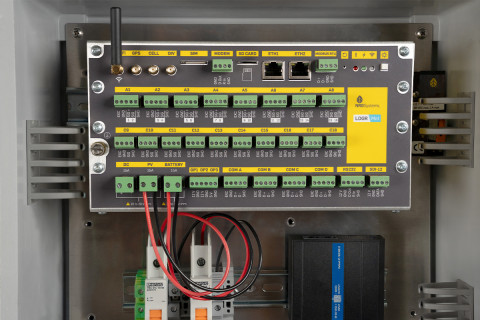
Our LOGR | Met Data Logger’s expanded serial channel capacity was designed to solve exactly that.
The Growing Demands of Modern Serial Sensors
Modbus RTU sensors now deliver much more than a single data point.
For example, the latest generation of heated pyranometers report not only Global Horizontal Irradiance (GHI), but also heater status, ventilation state, internal temperature, diagnostic flags, and operating hours – each requiring dedicated channels for logging.
Similarly, advanced all-in-one meteorological sensors may output temperature, relative humidity, barometric pressure, wind speed, wind direction, and precipitation, all from a single sensor.
Legacy data loggers, often limited to 24 or fewer serial channels, force difficult choices: either deploy multiple loggers, increasing cost and complexity; forgo valuable diagnostic data; or implement custom solutions that complicate data management and reduce system reliability.
LOGR | Met eliminates those constraints.
48 Serial Channels: Capacity Without Compromise
With support for up to 48 serial channels across four independently configurable COM ports, LOGR | Met provides the capacity to fully leverage modern sensor capabilities – without workarounds.
This expanded capacity allows you to:
• Connect up to 24 Modbus RTU sensors with multiple measurands per device
• Capture complete operational and diagnostic datasets from heated and ventilated pyranometers
• Support high-density, fully instrumented solar measurement systems without adding hardware
• Enable advanced soiling measurement configurations with clean/soiled panel tracking
• Conduct high-resolution performance monitoring for operational projects
Each COM port (A, B, C, and D) can be configured independently for baud rate, parity, and stop bits, allowing seamless integration of sensors from multiple manufacturers within a single measurement system.
As standards and technologies evolve, this flexibility ensures your measurement infrastructure evolves with them.
Simpler Systems for Stronger Data Integrity
Beyond raw capacity, LOGR | Met's design delivers practical benefits for data management and system reliability. By consolidating all measurements within a single logger, LOGR | Met maintains a unified timestamp across every channel, eliminating synchronization issues common in multi-logger deployments. Data files are coherent, complete, and easier to validate, analyze, and report.
The browser-based configuration interface provides full visibility into sensors and measurands, while real-time data display confirms communication instantly. Built-in COM-port diagnostics streamline troubleshooting, reducing time in the field and accelerating issue resolution.
Practical Value in the Field and Across Portfolios
Reducing logger count has tangible operational benefits. A single LOGR | Met deployment lowers hardware costs, simplifies installation, reduces power requirements, and minimizes wiring complexity. Fewer devices also mean fewer points of failure – another way LOGR | Met saves time and money spent on maintenance and field service.
At the portfolio level, standardizing projects on LOGR | Met drives consistency. Teams master a single platform, configuration templates can be reused, and data processing pipelines remain uniform across sites – regardless of sensor mix or project phase. That consistency strengthens operational efficiency and long-term data confidence.
Built for Today's Requirements, Ready for What’s Next
Solar measurement demands will continue to expand as projects grow more complex and even more data driven. LOGR | Met's 48-channel capacity provides the flexibility needed to scale without redesigning systems or replacing hardware.
Whether deploying a new resource assessment campaign, upgrading an existing operational monitoring system, or supporting hybrid wind/solar sites, LOGR | Met delivers the capacity, flexibility, and reliability modern solar measurement requires.
Learn more about LOGR | Met HERE and discover how expanded serial channel capacity can transform your resource measurement capabilities.